
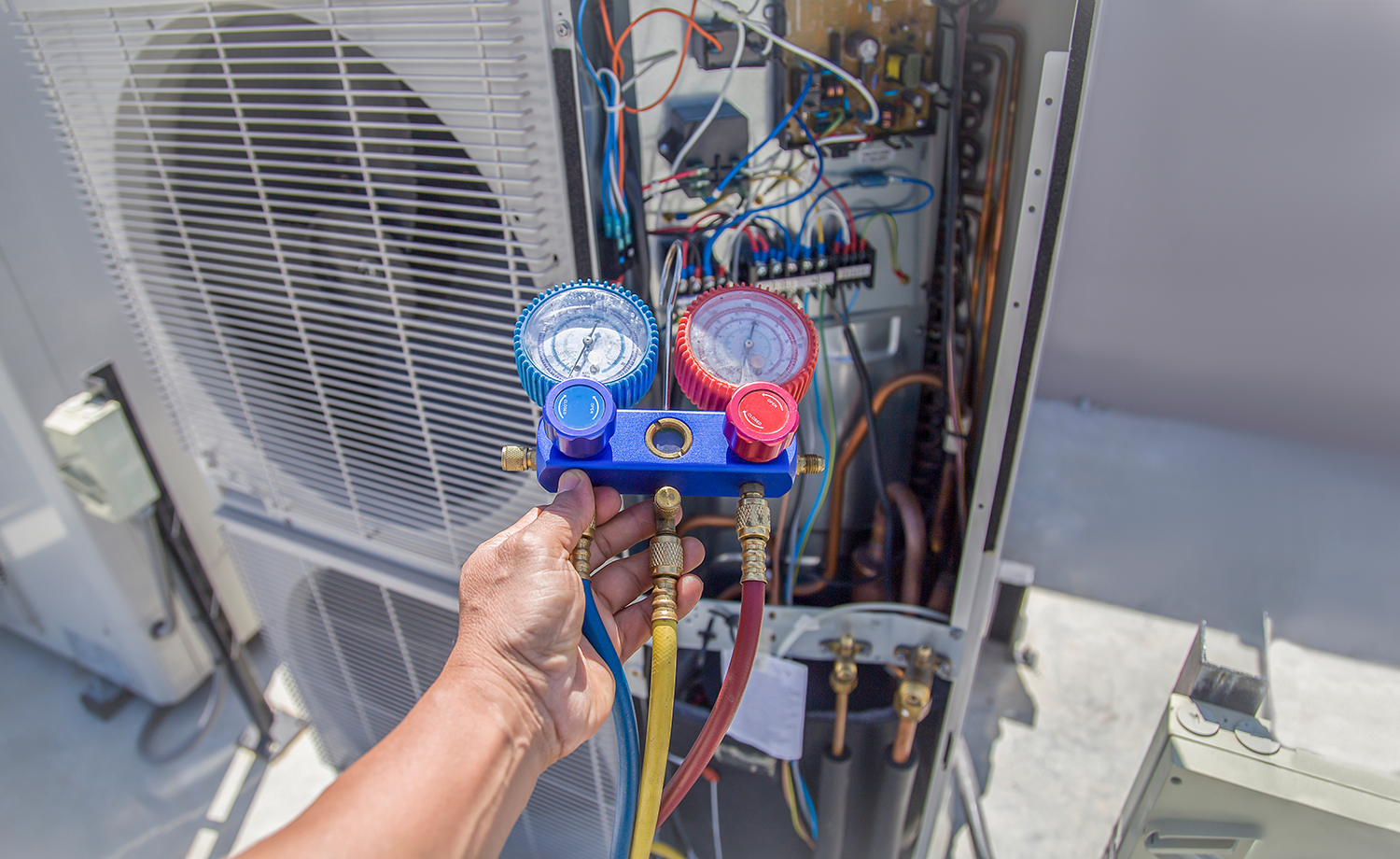
If you work in HVAC/R, you already know what refrigerant tracking is at a basic level: documenting what refrigerant was used, on which equipment, by whom, how much, and what happened to whatever was recovered. It is the paper trail that proves the work was done right.
What most people in the industry don’t realize is how much that paper trail now matters, who it applies to, and what happens when you can’t produce it.
Two Regulations, Two Thresholds, One Industry
Federal refrigerant compliance in the U.S. runs on two parallel regulatory tracks, and confusing them is one of the most common mistakes in the field.
Section 608 (40 CFR Part 82, Subpart F) has been around for decades. It covers ozone-depleting substances like R-22 and applies leak repair requirements to systems with 50 pounds or more of refrigerant. If you got your EPA certification years ago, this is the world you learned.
The AIM Act (40 CFR Part 84, Subpart C) is newer. It covers HFC refrigerants like R-410A, R-32, and R-454B, and as of January 1, 2026, it applies leak repair, inspection, and recordkeeping requirements to systems holding just 15 pounds or more of covered refrigerant with a GWP above 53 (§84.106(a)).
That 15-pound threshold is the number that changed everything.
Under Section 608, a 20-pound rooftop unit running R-22 didn’t require leak tracking. Under the AIM Act, a 20-pound unit running R-410A does. Hundreds of thousands of commercial systems, the kind found in restaurants, retail stores, office buildings, and light industrial facilities, crossed into active compliance territory on January 1, 2026. Many of the owners of that equipment have no documentation infrastructure in place.
One important exception: residential and light commercial air conditioning and heat pump systems are exempt from AIM Act leak repair requirements (§84.106(a)(3)(ii)). That exemption does not exist under Section 608.
Unfortunately the EPA has chosen to be ambiguous and leave the term “light commercial” undefined. This has led some to hope they fit “light commercial”, however by the time the question arises through audit and enforcement actions the debate and defense will cost more than the act of compliance.
What the Regulations Actually Require
The requirements are not complicated. They are just relentless.
Every time refrigerant is added to an appliance that meets the applicable threshold, the owner or operator must calculate the leak rate (§84.106(b)). If that rate exceeds the threshold (10% for comfort cooling, 20% for commercial refrigeration, 30% for industrial process refrigeration) (§84.106(c)(2)), the clock starts. Leaks must be identified and repaired within 30 days (§84.106(d)). Initial and follow-up verification tests must confirm the repair worked (§84.106(e)). If it didn’t, retrofit or retirement plans must be developed within 30 days and implemented within a year (§84.106(h)).
After a successful repair, ongoing leak inspections kick in (§84.106(g)): quarterly for systems with 500 pounds or more, annually for smaller covered systems. Those inspections continue until four consecutive quarters show the system hasn’t exceeded the applicable leak rate.
All of this must be documented. All of it must be retained for at least three years (§84.106(l)). All of it must be available for EPA inspection.
The challenge is not understanding these rules. The challenge is building a system that captures this information accurately in the field, at the moment of service, and makes it accessible to everyone who needs it without requiring anyone to re-enter data, chase contractors, or reconstruct records after the fact.
Who Carries the Risk
Here is the part most people in the industry don’t talk about.
EPA enforcement data through December 2025 shows 718 enforcement actions related to service level refrigerant regulations. Equipment owners represent 23% of those cases but bear 87% of the total enforcement costs, over $100 million combined. Contractors, by contrast, account for less than 6% of cases and less than 3% of costs.
The math is clear: when enforcement happens, the equipment owner pays.
That means facility managers, building owners, and operations directors are sitting on the largest compliance exposure in the industry, and most of them are relying on their contractors to keep records the contractor may not even be collecting, much less keeping. The documentation burden falls on the owner, but the service event happens in the field, off the contractor’s truck, through the technician’s hands.
This is the gap that traditional documentation has never been able to close.
The Old Way: Records That Don’t Talk to Anyone
Before connected compliance platforms existed, refrigerant records lived in filing cabinets, technician notebooks, and disconnected spreadsheets. A technician’s service history stayed with whatever company employed them. When a facility changed contractors, new technicians had no access to past service data. Recovery cylinders became a mystery the moment they left the warehouse.
The data existed. It just didn’t connect to anyone who needed it.
This was not a failure of effort. It was a failure of infrastructure. The tools did not exist to connect the people doing the work with the people responsible for the compliance record.
What Connected Tracking Changes
A connected refrigerant tracking platform closes the loop between the field event and the compliance record. When a technician documents a refrigerant charge digitally, that record flows to the contractor’s workspace, the facility owner’s compliance portfolio, and the technician’s own career record simultaneously. No duplication. No phone calls. No chasing paperwork.
Equipment carries its full service history, refrigerant type and charge data, and compliance status permanently. Cylinder transactions are tracked from registration through every charge, transfer, and recovery event. Leak rates are calculated automatically. Exceedance alerts fire when thresholds are crossed.
For equipment owners, this means compliance visibility without depending on contractors for documentation. When a regulator asks for records, it is a report, not a scramble.
For contractors, every completed service order becomes part of an audit-ready record before the technician leaves the site and the truck is back in the lot. Compliance stops being a liability and becomes something you can sell a prospective customer.
For technicians, their refrigerant documentation follows them from employer to employer. It builds a verifiable service history that distinguishes skilled, compliant professionals in a market where that distinction increasingly matters.
For wholesalers, full cylinder lifecycle visibility means supply going out, recovered refrigerant coming back, and every transaction in between accounted for.
The Bottom Line
Refrigerant tracking requirements are not new. But the AIM Act’s 15-pound threshold brought millions of additional systems and their owners into active compliance for the first time. The documentation requirements are specific, the timelines are tight, and the enforcement costs fall disproportionately on the people least likely to have a data system in place.
The question is not whether to track. It is whether your current process can hold up when someone asks to see the records.