Why Multi-Facility Refrigerant Tracking Is Different
Managing refrigerant compliance at a single facility is hard enough. Scaling that across dozens or hundreds of locations is a different problem entirely. Every site may have a different equipment mix, different service providers, different refrigerant types, and different compliance obligations. In most operations, there’s no single system that ties it all together.
If you’re responsible for a multi-site portfolio, you probably already know you’re supposed to have records. The harder question: can you tell right now whether those records are complete, current, and accurate for every piece of equipment at every location?
If the answer is “not really,” you’re not alone. But the EPA doesn’t grade on a curve, and neither do the states.
The Federal Baseline: Two Regulations, Two Thresholds
Federal refrigerant management falls under two regulations:
Section 608 (40 CFR Part 82, Subpart F) covers ozone-depleting substances like R-22. Leak repair requirements apply to equipment with a full charge of 50 pounds or more.
The AIM Act (40 CFR Part 84, Subpart C) covers HFC refrigerants like R-410A, R-454B, and R-32. Leak repair requirements apply to equipment with a full charge of 15 pounds or more.
That 15-pound AIM Act threshold pulls significantly more equipment into the compliance footprint, and it’s the one that changes the game for multi-site operators. Obligations apply at the equipment level, not the portfolio level. Each piece of qualifying equipment at each facility carries its own leak rate monitoring, repair timelines, and documentation requirements (§84.106).
When a piece of equipment exceeds its applicable leak rate threshold, the owner must document the leak, initiate repairs within the required timeframe, and maintain records of both the leak event and the remediation.
State Regulations: Where the Floor Becomes a Staircase
Several states have enacted refrigerant management programs that stack additional requirements on top of the federal baseline. For multi-site operators with facilities across state lines, this creates a layered compliance environment where the rules at one location may look very different from the rules at another, even for identical equipment.
No state can reduce the federal requirements. Even if states stipulate lower requirements, the Federal EPA is the baseline.
1. Leak Rate Thresholds
Most states that have adopted refrigerant management programs, including California, New York, New Jersey, and Colorado, follow the federal leak rate thresholds. Washington is the exception. It sets its own, stricter thresholds across all three equipment categories:
Leak Rate Thresholds: Federal EPA vs. Washington
| EQUIPMENT TYPE | EPA | WA |
| Comfort Cooling / AC | 10% | 8% |
| Retail Food Refrigeration / Cold Storage | 20% | 16% |
| Industrial Process Refrigeration | 30% | 24% |
Source:40 CFR §84.106(c)(2)&WAC 173-443-155(3)
Under federal rules, owners must identify and repair leaks within 30 days of a refrigerant addition that causes the equipment to exceed its applicable leak rate (§84.106(d)).
That’s the federal floor. For facility managers with equipment in certain states, it’s not the whole story.
That 2-6 point difference is significant in practice. A system leaking at 17% in a state that follows federal thresholds is compliant. In Washington, it’s an exceedance that requires notification to the Department of Ecology within 30 days and a repair within 14 days.
2. Repair Timelines
The federal 608 and AIM Act give equipment owners 30 days to repair a leak after an exceedance (§84.106(d)). Several states cut that window significantly.
Repair Timelines: Federal EPA vs. States
| REQUIREMENT | EPA | CA | NY | WA |
| Standard Repair Deadline | 30 days | 14 days | 14 days | 14 days |
| Extension: Tech/Parts Unavailable | File with EPA* | 45 days | 45 days | 45 days |
| Industrial Process Shutdown | 120 days | 120 days** | 120 days | 120 days** |
* Federal extensions must be filed with EPA within the initial 30-day window. If parts or labor are unavailable, the total repair window cannot exceed 180 days (270 days if an industrial process shutdown is also required). Extensions are considered approved unless EPA objects.
** CA and WA both require the facility to be subject to mandatory GHG emissions reporting to qualify for the 120-day allowance. NY does not have this additional condition.
CA, WA, and NY also allow 45 days (rather than the standard 14) when an industrial process shutdown is required but does not meet the qualifying conditions for the 120-day allowance.
Source:EPA §84.106(d),CA Tit 17 §95386(b),NY §494-2.4,WAC 173-443-165
If you have facilities in Texas, Washington, California, and New York, the same leak on the same type of equipment triggers a different compliance clock depending on which state it’s in.
3. Proactive Inspection Requirements
Federal AIM Act inspection requirements begin after a successful follow-up verification test following a repair: quarterly for equipment 500+ lbs and annually for equipment 15-499 lbs (§84.106(g)). California, Washington, and New York require proactive inspections regardless of whether a repair has occurred.
Routine Leak Inspection Frequency: Federal EPA vs. States
| EQUIPMENT SIZE | EPA | CA | NY | WA |
| 2,000+ lbs | Quarterly † | Monthly | Monthly | Monthly |
| 1,500-1,999 lbs | Quarterly † | Quarterly | Monthly | Monthly |
| 500-1,499 lbs | Quarterly † | Quarterly | Quarterly | Quarterly |
| 200-499 lbs | Annual † | Quarterly | Quarterly | Quarterly |
| 50-199 lbs | Annual † | Annual | Annual | Annual |
| 15-49 lbs | Annual † | — | — | — |
| On charge event (≥5 lbs / 1%) | Calculation only † | Inspection | Inspection | Inspection |
† Post-exceedance only. Federal inspections begin after leak rate exceeds the applicable threshold and repair is completed, and continue until four consecutive quarters below threshold. Federal charge events require a leak rate calculation, not an inspection.
No symbol = Routine. Required by equipment size on a recurring schedule regardless of exceedance history.
The critical distinction: the federal inspections are reactive (triggered by a repair event). California, Washington, and New York require inspections on a recurring schedule whether or not a leak has been detected.
Any leak detected during a routine inspection or charge event inspection starts the applicable repair clock.
Notes:
- WA requires notification to the Department of Ecology within 30 days of each charge event that recalculates above the leak rate threshold. Because WA uses a 12-month rolling average, the system may remain in exceedance for up to 12 months after a successful repair, triggering notification on each subsequent charge event during that window.
- All three states also require a leak inspection whenever oil residue is observed on any refrigerant circuit component or line.
Source:CA Tit 17 §95385,WAC 173-443-145,NY §494-2.3
4. Automatic Leak Detection (ALD) Requirements
Automatic leak detection systems continuously monitor refrigerant levels so that leaks are caught between scheduled inspections, not months later when a technician shows up and finds the system short. For large systems, they’re not optional. Federal and state regulations mandate ALD installation on the largest equipment, and every jurisdiction allows ALD to substitute for manual inspections on smaller equipment where the owner chooses to install one. The requirements differ on what size triggers the mandate, when installation was due, and what happens when the system fires an alert.
Automatic Leak Detection (ALD) Requirements: Federal EPA vs. States
| REQUIREMENT | EPA | CA | NY | WA |
| Mandatory for | Comm. Ref. and IPR, 1,500+ lbs | Refrigeration, 2,000+ lbs | Refrigeration, 1,500+ lbs | Refrigeration, 1,500+ lbs |
| AC equipment | Mandatory at 1,500+ lbs | Not mandatory | Optional (alternative to monthly inspection) | Not mandatory |
| Installation deadline | New: Jan 1, 2026; Existing*: Jan 1, 2027 | Jan 1, 2012 (in effect) | June 1, 2025 (or 30 days after new install) | Jan 1, 2025 |
| Location requirement | Components inside enclosed building | Circuit inside enclosed building | Not specified ** | Circuit inside enclosed building |
| Optional as substitute for inspections | Yes, for monitored portions † | Yes, all sizes (50+ lbs) | Yes, all sizes (50+ lbs) | Yes, all sizes (50+ lbs) |
| Response time after alert | Calculate leak rate within 30 days ‡ | Inspection within 24 hours | Inspection within 24 hours | Inspection within 24 hours |
| Annual calibration | Required | Required | Required | Required |
* Federal “existing” applies only to appliances installed on or after January 1, 2017 and before January 1, 2026.
** NY Part 494 requires ALD to cover the “entirety of the regulated equipment system” where mandatory, but the regulation does not explicitly limit the requirement to enclosed buildings the way CA, WA, and federal do.
† Federal inspections are post-exceedance only (see Inspection Frequency table). ALD substitutes for whatever inspection obligations apply. In states with routine scheduled inspections, ALD substitutes for both routine and post-exceedance inspections.
‡ Federal response to an ALD alert is to either calculate the leak rate within 30 days (120 days if industrial shutdown required) and comply with full leak repair provisions if above threshold, or preemptively repair the identified leaks before adding refrigerant and then calculate the leak rate within 30 days.
Notes:
- All four jurisdictions require identical detection specifications: direct detection systems must sense 10 ppm and alert at 100 ppm; indirect (performance-based) systems must alert when measurements indicate a loss of 50 lbs or 10% of full charge, whichever is less.
- Washington provides an exception: ALD is not required if the system will be replaced or retrofitted to use a refrigerant with a GWP below 150 before January 1, 2027.
- Where ALD covers only a portion of a system, the uncovered portions remain subject to manual inspection requirements in all jurisdictions.
Source:40 CFR §84.108,CA Tit 17 §95385,NY §494-2.3,WAC 173-443-145
5. Registration, Reporting, and State-Specific Programs
Federal regulations do not require equipment registration. Several states do, each with their own scope, deadlines, and reporting structures.
Registration and Reporting Requirements: Federal EPA vs. States
| Requirement | EPA | CA | NY | WA | NJ | CO |
| Equipment registration required | No | Yes | Yes | Yes | Yes | ODS * |
| Minimum equipment size for registration | — | 50 lbs | 50 lbs | 50 lbs | 50 lbs | 100 HP / 300 lbs * |
| Registration: 1,500+ lbs | — | Yes | Yes | Yes | Yes | Yes * |
| Registration: 200-1,499 lbs | — | Yes | June 1, 2026 | March 15, 2026 | Yes | Yes * |
| Registration: 50-199 lbs | — | Yes | June 1, 2028 | March 15, 2028 | Yes | — |
| New equipment registration deadline | — | Within 30 days | By June 1 of following year | By March 15 of following year | Within 90 days | Within 30 days |
| Equipment labeling required | No | No | Yes | No | No | No |
| Annual reporting required | No | Yes | Yes | Yes | Yes | No |
| Minimum size for annual reporting | — | 200 lbs | Varies *** | 200 lbs | 50 lbs | — |
| Annual report deadline | — | March 1 | March 31 | March 15 | April 1 | — |
| Exceedance notification to regulator | No † | No | No | W/i 30 days | No | No |
| Chronic leak reporting (125%+ annual loss) | Yes, by March 1 | No | No | No | No | No |
| Recordkeeping retention | 3 years | 5 years | 5 years | 5 years | 5 years | 3 years |
| Supermarket chain program | No | No | Yes †† | No | No | No |
| Registration fees | No | Yes | No | Yes | Yes | Yes |
* Colorado Regulation 15 requires registration for stationary appliances containing ODS refrigerants only. It does not cover HFCs. Refrigerated food appliances require registration at 300+ lbs ODS and air conditioning or industrial process with combined system horsepower of 100 or more.
** Colorado requires annual registration renewal within 60 days of November 1 each year.
*** NY annual reporting begins with large equipment (1,500+ lbs) by March 31, 2026 and medium equipment (200-1,499 lbs) by March 31, 2027. Small equipment (50-199 lbs) is not subject to annual reporting.
† Federal does not require proactive exceedance notification. However, extension requests for repairs exceeding 30 days must be filed with EPA, which functions as a form of exceedance communication.
†† NY Supermarket Refrigerant Program applies to chains operating 20 or more retail food facilities in New York (or 100+ nationwide) with supermarket systems containing 200+ lbs of refrigerant. Chains must register by June 1, 2025 and submit a Transition Plan by January 1, 2027 to meet GWP or emissions targets by January 1, 2035.
Source:NY §494,WAC 173-443-130,WAC 173-443-155,NJ N.J.A.C. 7:27E-2.1-2.4,CO 5 CCR 1001-19, Reg. 15 §III,CA Tit 17 §95380-95398
6. What Stacked Compliance Means for Multi-Site Facility Operators
The practical impact is straightforward: if you operate facilities across multiple states, you cannot manage compliance as a single set of rules applied uniformly. A facility in California may require monthly leak inspections, a 14-day repair window, state registration, and annual CARB reporting. A facility in Florida operating identical equipment may only be subject to the federal baseline.
Trying to manage this with spreadsheets, contractor invoices, and manual tracking is where multi-site compliance breaks down and violations lurk. Not because the rules are unknowable, but because the volume and variation make manual compliance unsustainable at scale.
The Contractor Documentation Problem
One of the most consistent frustrations for facility managers is the gap between the service work that was done and the documentation they actually receive. Contractors service equipment, technicians add refrigerant, but the paperwork (if it arrives at all) often comes days or weeks later, in formats that don’t connect to asset records or compliance calculations.
This isn’t necessarily negligence. It’s a structural problem. Most systems weren’t designed to connect the contractor’s records with the facility owner’s compliance portfolio. When both parties are working in the same connected platform, that gap closes automatically: the technician’s Field Service Order becomes part of the facility owner’s record the moment it’s submitted.
That’s the difference between chasing documentation and having it flow to you. In a stacked regulatory environment where states like Washington require exceedance notification within 30 days and repairs within 14 days, that difference can be the margin between compliance and violation.
Managed Assets and the Importance of Record Control
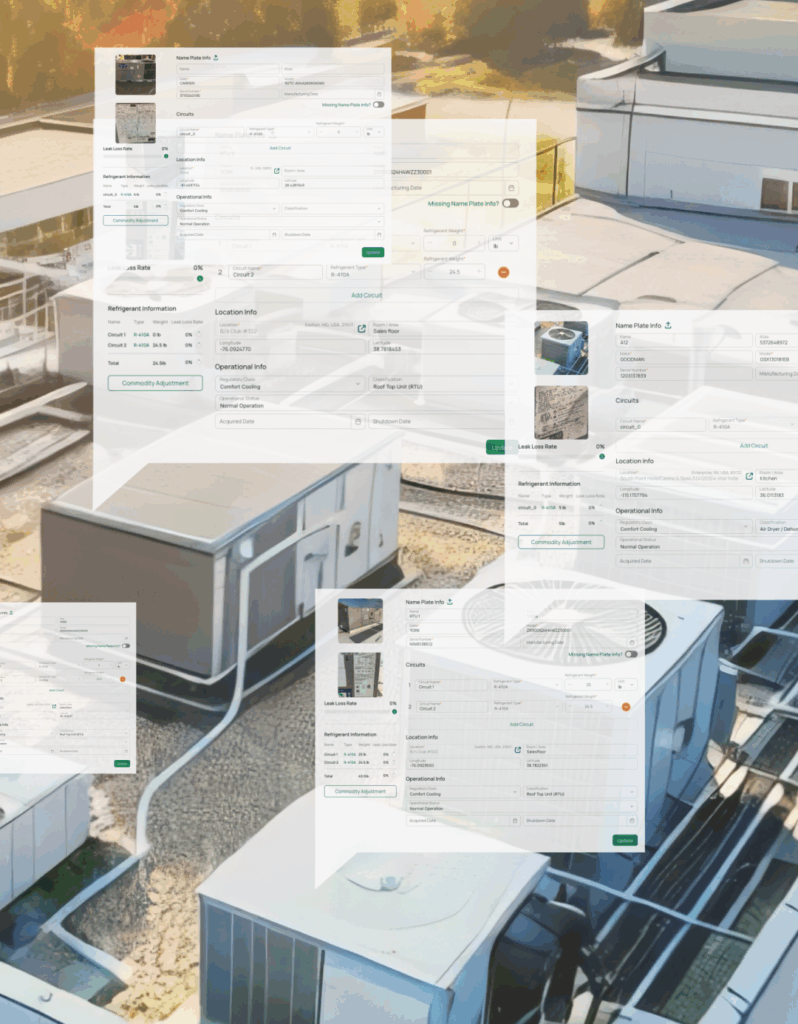
Not all equipment in a multi-facility portfolio requires the same level of oversight. FMHero distinguishes between managed assets (equipment that a facility owner has claimed and governs through an AssetOps subscription) and unmanaged assets that exist in the shared platform layer.
For regulated equipment, managing assets is the key to maintaining data integrity at scale. When an asset is managed, its core records (refrigerant type, charge amount, location) are locked against unauthorized changes. Authorized service providers can view and log work, but they can’t alter the baseline record without approval. This protection is what makes multi-facility compliance auditable: every asset has a controlled, owner-governed record, not a wiki that anyone can edit.
Federal regulations require compliance records be retained for at least three years (§84.106(l)). Many states require longer. When you’re responsible for hundreds or thousands of assets across dozens if not thousands of facilities in multiple regulatory jurisdictions, record control isn’t a feature. It’s the foundation.
What Good Multi-Facility Tracking Actually Looks Like
At its best, multi-facility refrigerant tracking gives facility managers a real-time compliance posture across their entire portfolio, accounting for both federal and state-level obligations. Every asset is tracked. Every service event flows into the record. Leak loss rates are calculated automatically. Exceedance alerts fire when state or federal thresholds are crossed, whether the threshold is a leak rate exceedance set at 20% (federal) or 16% (Washington), or a time-based inspection interval that varies widely across the map. When an auditor asks for documentation on a specific piece of equipment at a specific facility, it’s a report, not a scavenger hunt.
Connected compliance infrastructure makes this possible today. The question is whether your current systems are built for a regulatory environment that’s getting more complex every year, not less.
See how your portfolio looks in a connected compliance system. Book a demo at fmhero.com.