A technician recovers refrigerant from a rooftop unit and writes the details on a service ticket. Back at the office, someone enters that information into the contractor’s tracking system. The contractor emails a summary to the facility manager. The facility manager files it in a folder, maybe a spreadsheet, maybe a drawer. Weeks later, when the equipment leaks again or an auditor asks for records, everyone scrambles to reconstruct what happened, when it happened, and who was responsible.
The information existed at every stage. It just degraded a little each time someone touched it. A pound rounded here. A date estimated there. A technician’s name left off because nobody thought it mattered.
This is the documentation model the HVAC/R industry has accepted as normal. And it is the single biggest reason that equipment owners, contractors, and technicians find themselves exposed during enforcement actions.
Integration Where It Actually Matters
The industry loves the word “integration.” Every platform promises to connect with other tools, syncing data between this software and that software. But integrating tools is not the same as integrating people. A contractor’s field management system can talk to their accounting software all day long, and the facility owner down the street still has no idea what happened on their equipment last Tuesday.
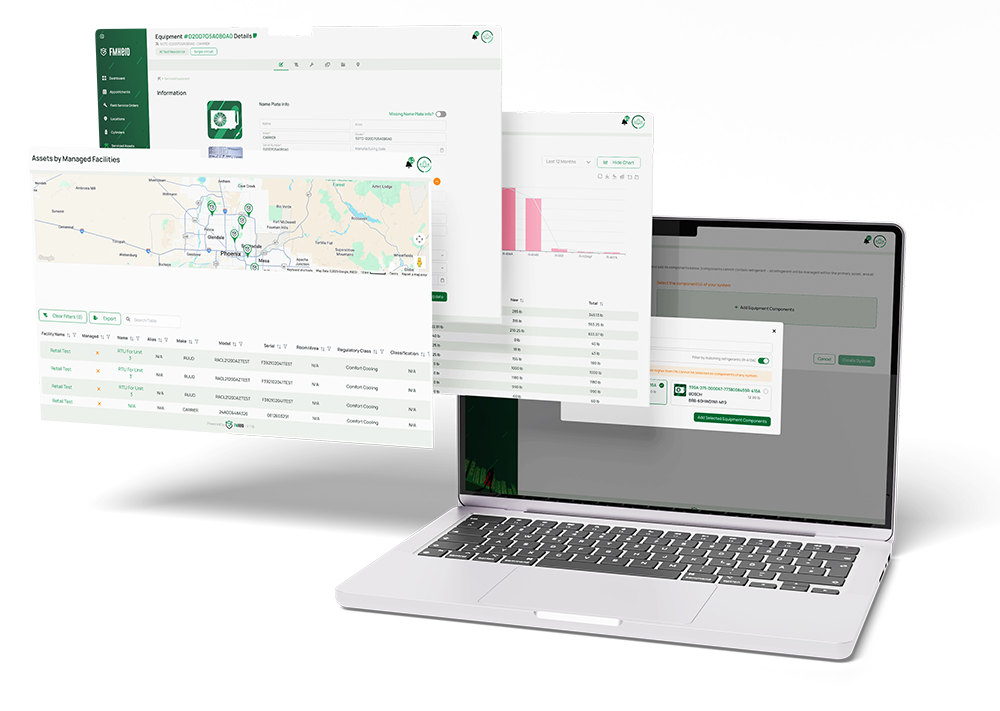
The Heroverse is FMHero’s connected compliance network, and it takes a fundamentally different approach. Instead of simply connecting tools to tools, it integrates the people who actually touch refrigerant compliance: technicians, contractors, and equipment owners, all working in one shared system. Every asset, every service record, every cylinder transaction, and every refrigerant event lives in a single connected universe.
When a technician documents a service event on a Field Service Order (FSO), that record does not stop with the technician. It flows, automatically and simultaneously, to every party who needs it: the contractor’s workspace, the facility owner’s compliance portfolio, and the technician’s personal career record.
No one re-enters the data. No one sends a follow-up email asking for a copy. The documentation happens once, at the point of service, and the system instantly delivers it everywhere it needs to go.
What Actually Happens When a Technician Submits an FSO
This is where the “builds itself” part stops being a concept and becomes concrete.
A technician arrives at a grocery store to service a rack system. She scans the equipment asset in FMHero, pulls up the unit’s full service history, and performs the work. She logs the refrigerant recovered, the refrigerant charged, and the cylinder used. She submits the FSO.
In that single submission, the system updates five things at once:
1. The equipment asset’s record
Now reflects the current refrigerant charge, the service performed, and the running service history for that unit.
2. The cylinder’s transaction log
Now shows the pounds removed or added, keeping the refrigerant custody chain intact.
3. The facility’s compliance portfolio
Now includes the service event in its leak rate calculations, automatically adjusting the numbers that determine whether the equipment is in or out of compliance.
4. The contractor’s workspace
Now contains the completed FSO as part of its audit-ready documentation, tied to the correct customer, location, cylinder, and asset.
5. The technician’s Hero Fame record
Now carries this service event as part of her professional history, a record she owns and takes with her throughout her career, regardless of employer.
All of that from one submission. No second entry. No email chain. No waiting on a report.
Privacy by Design, Accountability by Law
A connected system raises a fair question: if all records are shared, who sees what?
FMHero is built with user anonymity as a default. A technician’s identity is not exposed to parties who have no relationship to the work. Other users cannot see who performed service on assets they are not connected to.
The exception is intentional and legally required. Asset owners and possessors can see who performed work on their equipment. Refrigerant compliance demands a defensible documentation trail, and owners carry legal responsibility for the assets under their control. For that documentation to hold up, they need to know who did what. So do regulators during an audit.
The result is a system where technicians are protected from unnecessary exposure while facility owners maintain the accountability the law requires. Privacy and compliance are not in conflict. They are both designed in from the start.
The Bigger Shift
Remember standalone GPS units? They told you where you were, and that was about it. When GPS moved into a connected network across millions of phones and vehicles, the game changed completely. Suddenly you had real-time traffic, accident alerts, and rerouted directions because every device on the road was contributing to the same live picture.
The Heroverse is that same kind of shift for refrigerant compliance. The data has always existed: service events, refrigerant transactions, equipment records. It just lived in disconnected silos where it could not talk to anything. The Heroverse connects all of it. And just like GPS, the inter-connected network is what makes the data valuable.
The Network Gets Smarter the More People Use It
Every technician who submits an FSO in the Heroverse adds to the compliance picture for every party connected to that work. Every contractor who onboards their team expands the documentation coverage for every facility they serve. Every facility owner who connects to the platform gains access to a living compliance portfolio instead of a static file cabinet.
This is the network effect in action. Each participant makes the system more valuable for everyone already in it, including themselves. The documentation does not just build itself; it builds itself better with every person who joins.
See the Heroverse in action. Book a demo at fmhero.com